Showing posts with label movies. Show all posts

Wednesday, November 17, 2010

Opposites Attract: Making a big point with imagery and dialogue


by Jamie Freveletti

I'm a huge fan of classic movies (and songs). If you're a writer you need to watch the old ones to see just how conflict between women and men or evil and good should be done. I've been fairly outspoken about my dislike of the current "torture porn" movies and books. I'm not really blaming the writers, we all realize that the world we live in is getting more vicious by the year--one only has to watch the political attack ads to see that civility is long gone, but I do think that there is still a lot of room for finesse.

There's no putting the graphic scene back in the corner. We're seeing way too much violence in our world and media now to act as though it's not happening.

Do these books work? Yes. Are they going to last? Maybe. Should you write one? If you want, but before you go straight to the scene where the woman is strapped to the bed and being attacked you should probably watch some classic movies. These writers had to produce the same thrill and do it by igniting the imagination, not by writing an overt scene.

Case in point: What are these two going to be doing next? (Spoiler alert)
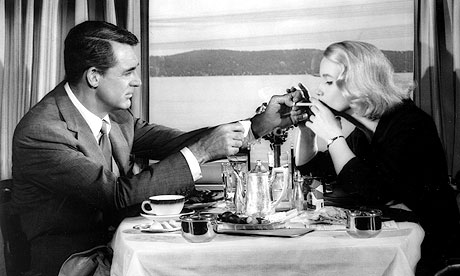


If you said making love, you would be right. This scene oozes sex, and just about everyone over a certain age can see it. They're at the end of their dinner (the coffee's on the table), he's doing something for her -an act of deference and a courtly gesture--and she's holding his hand lightly as she responds. Now, if you wrote this scene, but changed his behavior just slightly, everything changes:

What if she had asked for a light and he simply handed her the lighter? Would those two be racing to her room? I think not. And if you wanted to show that he is even more uninterested, or perhaps even a boor, you would have him toss the lighter on the table.

Second shot-- Look at the photo of Audrey Hepburn and Cary Grant above. Who flirting here?

Clearly the woman. Audrey Hepburn's next line, "How do you shave in there?" Great bit of dialogue that points out his cleft chin. If this scene was in a novel the fact that he had a cleft chin and she points at it and you added that line it would speak volumes about his looks without using the word "handsome" anywhere. These two also end up in bed, but only after he insists on marriage. Nice twist, and Cary Grant is the one who wanted to have the woman chase and the man hold out.

Contrast that with this scene:


He's definitely on the move and Doris Day is considering her next one--should she say yes or no? Since it's a Doris Day movie she says yes only after safely married. But if you write a scene that describes a man stepping up behind a woman, gently placing his hands on her bare shoulders, and whispering in her ear, that paragraph screams intimacy and approach, and you never once have to clarify his intentions.


But conflict is always best when writing mysteries and thrillers, and this photo says it all:


What I like about this scene is he's angry--his face shows it and he's got her by the wrist--but look at her, she's not intimidated at all. Her chin is up and she remains relaxed and doesn't try to pull her arm away--all moves that a writer would describe if she wanted to send the message that the woman is not worried. Here Grace Kelly's character looks like she's still got the upper hand: and she does, because he doesn't leave--they end up...

Having sex-okay some behavior is universal and I guess when you're Cary Grant you end up having a lot of sex in your movies, but in this case it was unclear whether he was going to go for it. For most of this movie Grace Kelly's character spends her time chasing him in order to unmask him as the famous cat burglar and he was fascinated by her but more often than not angry, too. In the actual movie the ending was changed. Initially Hitchcock had them going their separate ways, but he was pressured to change the end to a more "hollywood" happy one. He does it with a funny little twist.

I like the subtlety of the classics. I like the challenge of making a statement without overtly saying it, and I don't always get it right, but I hope to keep working at it. Thrillers generally require broader images, but readers notice the small ones too. Here's to adding more of those!


Wednesday, November 10, 2010

Bigness

by Marcus Sakey

As those of you who follow me on Facebook know, I often post questions. Part of the reason is that I find the whole social media thing a little me-me-me oriented, and as a good Midwestern boy, I was raised to find relentlessly talking about myself impolite. But the larger part of the reason is that I'm fascinated by the answers.

Yesterday, my question was this: "What's a book or movie that you've read or watched over and over? Ready, Go."

As of this writing, 49 people have responded. Here are some of the big winners, mentioned multiple times:
  • To Kill A Mockingbird (book and film)
  • The Star Wars Trilogy (the real one, not the one for the kiddies)
  • The Last of the Mohicans (film)
  • The Lord of the Rings (films)
  • Catcher in the Rye
  • North by Northwest
  • The Godfather
  • The Shawshank Redemption
  • Mystic River
This is, at first glance, one weird ass list.

But the more I look at it, the more sense I see. These are all big titles, by which I don’t mean so much that they made a lot of money, though they did, or that they were sweeping in scope, though most of them were.

No, the bigness I mean here is something else. It’s an ineffable sort of bigness. A sense that the story has weight, heft. Something that will endure.

That makes sense, of course, since my question was about books and movies that people have enjoyed multiple times. But as a writer, it’s also an interesting and daunting thing to recognize.

Something made these big. It didn’t just happen. A quality in the idea, or in the telling, or both, took these beyond the norm.

The vast majority of books and movies come out, live their day, and fade into the background. They aren’t lost, but they aren’t likely to get three or four mentions on a list like this. They aren’t likely to haunt the collective imagination of a wide group of people.

If I have a point, I suppose it’s this—I wonder if, as writers, this is a worthwhile test to apply to our own work. It would be a painful one, no question. This is a scary ass hurdle to put before yourself while you’re trying to create something from nothing.

But maybe it’s a good one. Maybe it can help. Maybe, if nothing else, aiming for bigness has value.

Meanwhile, I’d love to see more answers to this question. What book have you read a number of times? What movie can you always watch again?

Ready, go.

Tuesday, March 09, 2010

Writers, The Oscars, and “Sickly little mole people”

I laughed at Tina Fey and Robert Downey Jr. when they faced off while presenting the original screenplay award. Their byplay was light, comic, and had just the right amount of truth about how writers feel about their words.


But the question remains: are we writers “sickly little mole people?”


Perhaps.


I’m debut, so I have a fresh view of this new world that I’m frequenting, and I can tell you that as a group I find writers to be friendly, interesting, curious, intense, and laugh out loud funny. They’re often quite a bit more relaxed than lawyers, (the world I inhabited for most of my career) and definitely less stressed.


There is an aspect to crime, mystery, and thriller writers that goes a step further. They’re excellent observers of people, and are able to inhabit the mind of their antagonists with often haunting reality, and, yes, this tends to lead to some peculiarities among them. There are some who retreat to their condos for days at a time, emerging only to get a restock of the whiskey and some bagels, some who spend their time writing from midnight to five am and then sleep all day, and some who are so impressed with themselves that they forget to be gracious.


I imagine that you can think of a few people in your own profession that act exactly the same way. The deal with writers, though, is that we can do all this to an extreme, because others will shrug, call us “creative,” and give us a pass. If you’re the nurse working the day shift and showing up late for work, you probably won’t get the same consideration.


I couldn’t help but agree with Tina Fey, though, that for all their quirks, writers create the stories that the actors bring to life, and dialogue in the story is often the key to the telling when you're dealing with a screenplay. A writer sweats blood to have a character say just the right line at the perfect time. If the writer does her job, the dialogue should fit the character, advance the story, and seem completely natural. For an actor to improvise and change the line can often defeat the purpose. It’s a little like working with an editor. They give you nudges, debate the merits of a line, paragraph, or word choice, and in the end it becomes a bit of a compromise between you as to how the sentence will finally read.


While I laughed through the interchange between Downey and Fey, I still knew that Fey was on the better side of things. I’ll bet she wrote the “sickly little mole people" line that Downey used as the perfect retort. After all, she’s a writer.


Tuesday, September 16, 2008

Perfect Stranger(s)

by Michael Dymmoch

I recently watched two movies with nearly identical titles. Both were billed as thrillers. Both had the requisite set pieces and reversals, talented direction and great casts. Filmed in NYC, Perfect Stranger (James Foley, 2007) featured Halle Berry and Bruce Willis. The film was a slick, well crafted Hollywood product that delivered on the promise of its trailer, but I’m glad I didn’t pay ten bucks to see it in a theater. I got the impression that the final outcome was determined by test audience reactions rather than character development. I doubt that I’ll remember the film six months from now, or bother watching it again.

Perfect Strangers (Gaylene Preston, 2003) starred Rachael Blake and Sam Neil and was made in New Zealand. Beyond budget and setting, it couldn’t have been more different. Though it starts predictably—girlfriends heading to a bar after work, it takes a turn for the bizarre when Neil asks Blake, “My place or yours?” After watching it, I felt that getting the DVD on Amazon was like finding an Ivan Albright at a garage sale.

The test of a great story is how it resonates after the fade-out. Do the images linger? Are the characters people you’ll continue to wonder about? Was the ending inevitable and satisfying? Do you feel you got a little something more?

If you’ve seen these films, how do you think they compare?

If you haven’t seen them, check ‘em out.

Monday, July 28, 2008

The (Very) Dark Knight . . .

-Sean Chercover

Okay, so I saw the Batman movie. I mean, the new one. The Dark Knight. And, yeah, everyone is right. It's a great movie. No, it's not as deep as it pretends to be, but I didn't go to the theater expecting a philosophical debate. It's a movie based on a comic book, and as you might expect, it paints in broad strokes. There is no subtlety here.


And it is very dark. The Wall Street Journal's Joe Morgenstern found it "suffocatingly dark" in his mixed review. I don't disagree with any of his review, although I enjoyed the movie more than he did. My date did not enjoy it quite so well. Not that she thought it a bad movie, just that, like Morgenstern, she found the unrelenting darkness suffocating and left the theater feeling depressed about the human condition (and by what we watch for 'entertainment' says about the human condition).

Do NOT take the kids to this movie, but do go see it without them. It is, by a mile, the best Batman movie ever, and it has the best comic book villain ever. Alfred Molina was excellent as Dr. Octopus in Spiderman 2, but Heath Ledger's performance as The Joker is even better - and every bit as good as the hype surrounding it...


Sure, there are nits to be picked. I think they went overboard with the Two-Face makeup - instead of being horrified, I just found it silly. If they'd pulled back a bit, it would've been realistic enough to be truly horrifying. And while I get the point of lowering the pitch of Christian Bale's voice when he's in the bat-suit, a more delicate approach would've been an improvement. The film's action sequences are somewhat disconnected from the rest of the story, there's some over-caffeinated editing (as you find in most "big" movies these days) and you could trim the film by 20 minutes without hurting it (again, something you find in most "big" movies these days).

Any other nits would also be spoilers, so I'll leave them unspoken.

Other points of praise - Chicago is absolutely gorgeous in this movie and both LaSalle Street and Lower Wacker Drive are used to their best advantage. It really is a beautiful film to watch. The performances are good all around. And most of all, this is the first time a Batman movie has really captured the darkness, the chaos, the corruption, and the psycho hero/villain duality that makes the comic so appealing.

The Dark Knight is very good, worth seeing, and definitely too dark for the youngsters.

Monday, July 14, 2008

Take the $ and smile

by Michael Dymmoch

In the late ‘80s, I had an idea for a movie I thought would be perfect for Sean Connery. I didn’t know anyone who knew Sean Connery, or anyone else in Hollywood. I’d never written anything longer than a short story or had anything published but bad poetry. Because I had no clue about how to get my idea to Mr. Connery (or if he’d be interested if I did), I went to the library and took out books on screen writing. I followed the directions and wrote my idea into a screenplay. I even lucked out and got someone in Hollywood to read it. When he called me to discuss it, he gushed about what a great writer I was.

But ...

Maybe I could rewrite the script to make it more like Back to the Future or A Connecticut Yankee in King Arthur’s Court. And why not call him after the holidays to discuss it?

I never called. Green as I was, I realized it would be easier to write another story from scratch than to rewrite my story to fit his ideas. Eventually I novelized the screen play; finally published it, The Cymry Ring, in 2006. (And I have a rewritten script available if anyone’s interested, though Mr. Connery is now too old to play the lead.)

Today I know people in Hollywood, though it isn’t any less crazy. And it’s no easier to get a story made into a movie. Everyone involved wants to make his contribution. People whose only qualification for writing is that they watch movies and have read Syd Field’s book want to tell the writer how to improve the script. Everything has to be like something else. Only different.

It’s all about the story. But...

Like publishers, movie companies have been bought up by international conglomerates. Except for indies—financed by indie film makers, passionate fans, and dentists—movies are made today by For-Ginourmous-Profit corporations, that don’t care if a movie makes sense as long as it makes money. And American audiences want circuses and happy outcomes. Very few writers have the skill to pull off a deus ex machina ending that works. (Neil Jordan comes to mind.) Writers have to know this to make it in film. (So if you want your book on the screen, exactly as you wrote it, you'll probably have to film it yourself.)

For novelists, adapting our own work is hard. Cutting a 300+ page novel into a 95-110 page screenplay—without gutting the story—is an art-form in itself. Best selling author and screenwriter Lee Childs has said he doesn’t want to adapt his own books. (And he gets hired to fix other writer’s scripts.)

Novelists realize the Moody Blues were right: Thinking is the best way to travel. And the cheapest. Actors are expensive, especially when they have speaking parts and box office draw. And car chases really co$t. Novelists don’t have to get permission to write a shoot-out in a public place. Or worry about crowd control, collateral injuries, lawsuits... Or idiots wandering through the scene demanding autographs.

We novelists don’t want anyone tampering with our characters or stories, but we don’t have to worry about convincing a bankable star or competent director to sign on. Even when the characters have minds of their own, we don’t have to settle disputes about who gets top billing, or think about whether the weather will cooperate or who’s going to pay the caterer and that long list of people named in the credits.

One of my books has been optioned; I wrote the SP. At the request of the producer, I’ve eliminated characters, added a chase, and blown up a boat (or maybe it’ll be a car if the movie gets filmed in winter). And the producer's indicated he wants the villain to have a larger role. He has his reasons. And they’re good ones from his point of view. Maybe the movie will never be made. Maybe a studio will buy the rights and hire a “real” screenwriter to rewrite it. And if they change everything but the title, I won’t care. They’re not gonna change my novel.

So I’ll cash the check and wish them luck. I’ll take the money and smile.

Tuesday, June 26, 2007

Love Won't Be Calling At Your Address

By Kevin Guilfoile

One thing I remember about growing up was that my dad was really excellent at not murdering us. He had a look that made us believe he might kill us even when, it turns out, murder was never really an option.

Not killing your kids is a lost parenting art, apparently.

Experts (whoever they are) claim that the number of incidents of familicide are still quite rare and have remained fairly consistent over the years. They say that when parents murder their children it's always a sensational case and the overreporting in this modern era of media saturation makes it seem like such events are more common now than they actually are. I'll take their word for that, although last month surely represented an unprecedented spike in frequency.

In Chicago the papers are fixated on the case of Christopher Vaughn, who is accused of shooting his wife and three children on a June 14 daytrip to a downstate water park. The local papers ask how a man could commit such an unthinkable crime. It was a "coldly planned execution at dawn," Eric Zorn wrote yesterday. "A betrayal of love, trust, decency and biological imperative so complete it redefines the standard of everyday evil."

Similar columns are being written in San Francisco, but Christopher Vaughn isn't on their radar. Out there the name they're putting on everyday evil is Kevin Morrissey, who on June 18 similarly pulled his car over to the side of the road and murdered his wife and their two children before killing himself.

In Montclair, New Jersey it's Thomas Reilly, who drowned his two daughters on June 21 and then hanged himself, just hours after their mother had dropped the girls off for a visit.

In Delavan, Wisconsin the name is Ambrosio Analco, accused of killing his twin infant sons on June 9, along with his ex-girlfriend and two other people before killing himself.

In Griffith, Indiana it's Mickey Gordon who on June 10 killed his teenage stepdaughter before, of course, killing himself.

Now there is the case of professional wrestler Chris Benoit, who apparently strangled his wife on June 23, his seven-year-old son on June 24, and then, after placing a Bible next to each of their bodies, hanged himself with a weight machine pulley.

And I don't need to tell anyone about Bobby Cutts, Jr. who on June 14 allegedly killed his ex-girlfriend and their unborn child right in front of their three-year-old son.

For those of us who are parents there is something especially repellent and fascinating about a father killing his children. But it's different than fear. There are an almost infinite number of things that I worry might harm my children but obviously I don't worry at all that my boys will be murdered by me.

Maybe that's why there seem to be so few fictional villains whose target is their own family. We might have a visceral reaction to these cases--we might be appalled--but we never think our own family might be in similar jeopardy. The prototypical villain of fiction is the murderer who chooses randomly. The killer who picks his victim because he or she is in the wrong place at the wrong time. That is somebody we can all fear.

(There are exceptions of course and I'd love to hear examples if you have them. The Stepfather is an underrated horror film in which the new head of the household is a serial killer. Terry O'Quinn's performance in that film is so good that 20 years later, when his character does something on Lost and I miss it, my wife still recaps it by saying something like, "The Stepfather just opened the hatch.")

Writers also like to have a motive for the crime and when a father kills his family we are frequently left with no explanation at all. According to forensic pyschiatrist Dr. Louis Kraus, when a woman kills her family it's frequently the result of a mental illness. The mother is depressed or she thinks the children are in some imagined jeopardy and using the logic of insanity decides that the only way to save them is to kill them.

When fathers kill their children, Kraus says, they are less likely to be insane and more likely to be narcissists and sociopaths for whom fatherhood has become inconvenient.

It's the new mid-life crisis. Murdering your kids is the new sports car.

When the killers take their own lives we rarely get any hint at motive. Benoit allegedly sent disturbing text messages to his friends while he was in the middle of his household killing spree. Perhaps that evidence will explain something.

On Memorial Day, 1998*, Daniel LaMere of Gurnee, Illinois sat down at his computer just moments before he would take a shotgun and kill his wife, his two stepchildren, and then himself. He typed:

"I guess your (sic) wondering why I did it. I have stayed as long as I can, but time has run out."

[Note: The original post of this article misstated the year in which this event occurred.]

Monday, June 11, 2007

Everybody Wants a Thrill

By Kevin Guilfoile

Lots of people have asked me what I thought of The Sopranos finale last night. Many of those people are angry. Like them, I had been expecting something different from the show and so I went to bed not certain how I felt about it. When I woke up this morning (no A3 reference intended) I realized the profound statement Sopranos creator David Chase had just made about storytelling and I was sure that I loved it.

In fiction characters live their lives episodically. We drop in at a particular point and drop out at a particular point and everything that happens in between ties up nicely along the way. Presumably the characters get up the day after the story ends with blank slates. No worries, no debts, no obligations until the next episode starts. It's a manipulation done to satisfy us. Real life, we all know, is a lot messier and a lot weirder.

[BEGIN SOPRANOS SPOILERS]

In the final scene Chase pulls out every manipulative trick in the filmmaker's bag. The two strangers in the restaurant are doing nothing suspicious and there is no reason to think they have designs on Tony except that Chase keeps cutting back to them. Outside Meadow is having trouble parking. Perhaps this happens every time she tries to parallel park but Chase keeps returning to it and suddenly it's ominous. One of the strangers gets up and walks into the bathroom. Anyone who has seen The Godfather knows there's always a gun hidden in the restaurant toilet and we just saw Phil Leotardo killed in front of his wife and grandchildren. The automatic symmetry creator in our heads is already storyboarding the next cut. It's a brilliant scene.

Much has been made about the fact that Journey's Don't Stop Believin' is playing in the restaurant at the time. Some think it's ironic and we're supposed to assume the worst after the screen goes black. Others try to sap meaning from the song's title. But it's obvious why Chase chose it:

Some will win, some will lose
Some were born to sing the blues
Oh the movie never ends
It goes on and on and on and on


There is no place to end this story. Endings are arbitrary and artificial. It doesn't matter if Tony is about to be whacked in front of Carm and the kids, or if they will just finish a quiet meal and go home. Either way it's not an end to the story, it's middle. The Sopranos was all middle, riddled since the series premiere with red herrings and slow parts and unresolved storylines. Our lives are all middle, too. We never get many answers, and the real story just goes on and on and on and on.

[END SPOILERS]

It goes on this month in a federal courtroom where "the last big Outfit trial in Chicago history" begins. Among the 14 defendants will be reputed former boss Joey "The Clown" Lombardo (not to be confused with fictional New York boss Phil Leotardo). Lombardo is alleged to be a brutal gangster who ordered the killings of even close friends including the father of his own godson. A famous cut-up, Lombardo is employing a bizarre defense, claiming that he was never really a part of the mob and even if he was he voluntarily left that life a long time ago. To bolster that claim, Lombardo's attorneys will show the jury a full page newspaper ad that Lombardo took out in the early nineties daring anyone who saw him associating with mobsters to call his parole officer. Um, yeah, no one took him up on that.

One of the main witnesses for the prosecution is former Outfit hit man Frank Cullotta. Cullotta's been a federal informant for over two decades and unlike Lombardo he flaunts his long ago connections. In one of the most bizarre turns in mob (or mob movie) history, Cullotta actually played himself in Martin Scorcese's film Casino, graphically reenacting his 1979 murder of barber union head Jerry Lisner. (Cullotta was also the inspiration for another character in Casino, Frank Marino. Marino was played by Frank Vincent, who by the way played Phil Leotardo on The Sopranos.)

During a Saturday break from the Printers Row Book Fair we were sitting at Kasey's Tavern on Dearborn, just blocks from the skyscraping correctional facility where Lombardo is awaiting trial, and I told Cullotta's story to CJ Box. He shook his head and said, "If you tried to put that in a novel you'd never get away with it."

And David Chase knows it.

Monday, June 04, 2007

Is There Such A Thing As Too Fast?

by Marcus Sakey

Recently, I dragged my wife g.g to see 28 Weeks Later. I'm not particularly a horror fan, but a well-told zombie tale is something different, and the reviews were startlingly positive, praising the political acumen and dark tone. As a general rule, g.g. doesn't like movies with explosions and blood sprays, but after reading the press, she was willing to give it a chance in the hope that the suspense and intellectual elements would overwhelm the gore.

Suffice it to say, I owe her the chick flick of her choice. That was settled the first time thumbs went through eyeballs. But besides being far bloodier than necessary, to me, the movie had a deeper flaw.

It went too fast.

I don't mean it started too fast. I'm all about jumping into the middle and trusting the intelligence of the audience. No, what this movie did was press down on the accelerator and then never let up. Ever.

On the surface, that sounds good. But there came a point between escaping fire bombing, stumbling through corpse-strewn tunnels, machine gunning civilians, and endlessly running from incredibly fit zombies (apparently being zombified is a great diet--not a beer belly in sight, and they sprint like entrail-spattered Olympians), when I realized I just didn't care. I didn't care if the protagonists made it out. I didn't care about the wise doctor or the stoic soldier. I didn't even care if the plucky little boy got his head gnawed. Actually, I was kind of hoping for it, because I figured that would signal the end of the movie.

My friend Joe Konrath and I have an ongoing discussion about this. He's of the belief that keeping the action unrelenting is a good thing. That you never want to give an audience, or a reader, a point to quit.

But for me, it has to come in waves. I want to care about the characters, to find something in them to relate to. Certain traits can be conveyed well in action scenes--resourcefulness, courage, even a sense of humor--but to my mind, you can't really get to know anyone if all you do is see them run and shoot and bleed. And if I don't know 'em, I don't much want to follow their story.

That very fact is what makes the technique work in a medium like video games. In a video game, I do want to run and shoot and bleed, and I want very little else. Long cutscenes or "get to know you" moments drive me up the wall. But the difference is that I'm controlling the character, so although I'm not moved emotionally, I am physically involved, and the balance is maintained.

My concern is that "pedal-down" style seems to be a trend. There are an increasing number of novels written this way, books that focus on never letting up. Some work better than others. But the trend is most common in TV and film.

Take 24; while never exactly Tolstoy, in the glory years it featured developed characters, and while there was always an overwhelming threat, much of the tension came from the smaller crises in each episode, often rooted around emotional and personal challenges. In the later years they lost that, and decided that what we wanted was all action, all the time. As a result, this season I gave up by the second episode, when I realized that I wouldn't save any of the characters if they were drowning in a bathtub.

So what do you think? Is it me? Do you like it when the accelerator never leaves the floor? Or is breathing room a good thing?

Friday, May 04, 2007

Movies With Guns

by Marcus Sakey

I love movies. I especially love crime movies. I don't mean gangster films, or at least not specifically those; I mean movies that explore the seamier side of life, that are unabashed about having a plot and yet also handle character with grace and explore a larger issue.

Here's the problem. There aren't enough of 'em. And a lot of great ones slip through the cracks.

Ever see Spy Game? Odds are you didn't. It was badly trailered, promoted as a sort of pretty-boy actionfest. In truth, there's not much of what you'd call action. But it's a masterful film about loyalty, about country, about the things we can convince ourselves to do for a cause we believe is larger than ourselves--and what happens when we're wrong.

Plus it's damned entertaining.

How about The Peacemaker? George Clooney and Nicole Kidman chasing a load of stolen nuclear weapons. Not new in its own right, but handled with sophistication and subtlety, and every character, good and bad, is smart, motivated, and believable. The subject matter, timely when it came out, now plays as damn-near prescient. And it's even fairly accurate about nuclear weapons, something you just never see.

Obviously, no one needs me to recommend The Usual Suspects, or Goodfellas, or Silence of the Lambs. But did you ever see Manhunter, the first movie to introduce Hannibal Lector, chillingly played by Brian Cox? Okay, the soundtrack is a little eighties, but the film is otherwise fantastic, in many ways the equal to its Academy Award winning sequel.

Miller's Crossing may be the smartest (and oddest) gangster movie ever made. Lock, Stock & Two Smoking Barrels is a perfect film, without a wasted scene or throwaway moment. Bound is so painfully tense it's hard to sit through. I watched Layer Cake three times in two days, and I could fire it up again right now.

So those are some of my favorites. What are some of yours, and why? Help a brother out--otherwise I'll just end watching Training Day for the fifteenth time.